

This article is part of a longer body of work exploring how leadership, judgment, and responsibility are changing as AI begins to participate in thinking itself.
This is the eleventh essay in the series, focused on leadership posture, governance, and board-level responsibility.

AI can inform nearly every consequential choice a company makes. That is exactly why a small core of judgments must remain unmistakably owned by humans.
The real governance question in the AI era is not whether the board approved the system. It is whether the board quietly allowed the system to inherit judgments the board was never supposed to surrender. Delaware law gives a narrow clue by identifying certain acts that cannot be delegated. But the deeper issue is not legal. It is fiduciary. Someone still has to own the company’s intention, its risk appetite, the truthfulness of its reporting, the choice of its leaders, the commitment of its capital, and the standards by which it is willing to live. And now AI touches every one of those judgments. It shapes strategy. It alters risk. It mediates what management sees. It influences who gets trusted, funded, escalated, or ignored. Which means the question is no longer whether AI is involved. It already is. The question is whether leaders remain unmistakably accountable for the decisions that define the enterprise.
There are, in fact, a few things that are formally non-delegable under Delaware law. Board committees may exercise broad authority, but not everything. The statute withholds certain fundamental acts from committee delegation, including adopting merger agreements, recommending dissolution, and amending the certificate of incorporation; bylaw amendments and some capital actions are also constrained unless specifically authorized. That matters. But it is not the heart of the matter. The statute is the hint, not the thesis.
The more important truth is older and broader: every company has a small set of judgments that cannot really be handed off without losing something essential. Not because the system is weak. Not because the model is immature. But because these judgments do not merely optimize the company. They define it. Mainstream governance guidance puts this in different language, but it converges on the same point: boards are responsible for overall strategy, major policy choices, risk oversight, and the integrity of reporting and control systems.
That is the line leaders are now in danger of crossing.
For years, delegation meant committees, executives, business units, outside counsel, advisors. The board could delegate work without delegating accountability. But AI introduces a different temptation. A recommendation engine can seem more comprehensive than a memo. A triage model can look more disciplined than a manager. An automated scoring layer can appear more objective than a room full of humans. And because these systems are often useful, leaders begin to let them settle questions that were never merely operational in the first place.
That is the mistake.
A board can delegate work. It can delegate review. It can delegate workflow. It can delegate monitoring. It can even delegate large portions of decision preparation. What it cannot delegate is responsibility for determining the intention of the company and standing behind the consequences of that intention. In Delaware terms, directors’ core fiduciary duties are duties to the corporation and its stockholders. In practical terms, that means they must act on an informed basis and in those interests rather than surrendering judgment to convenience, passivity, or conflicted motive.
Put more plainly: someone still has to own the call.
The Shift·Lift subscribers have full access to all past articles, including the work that led into this series. Be sure to order your copy of CRAFT Thinking™ available on Amazon; Free for Kindle Unlimited readers.
The Non-Delegable Core
That ownership lives in a small non-delegable core.
Intention Still Belongs to Humans
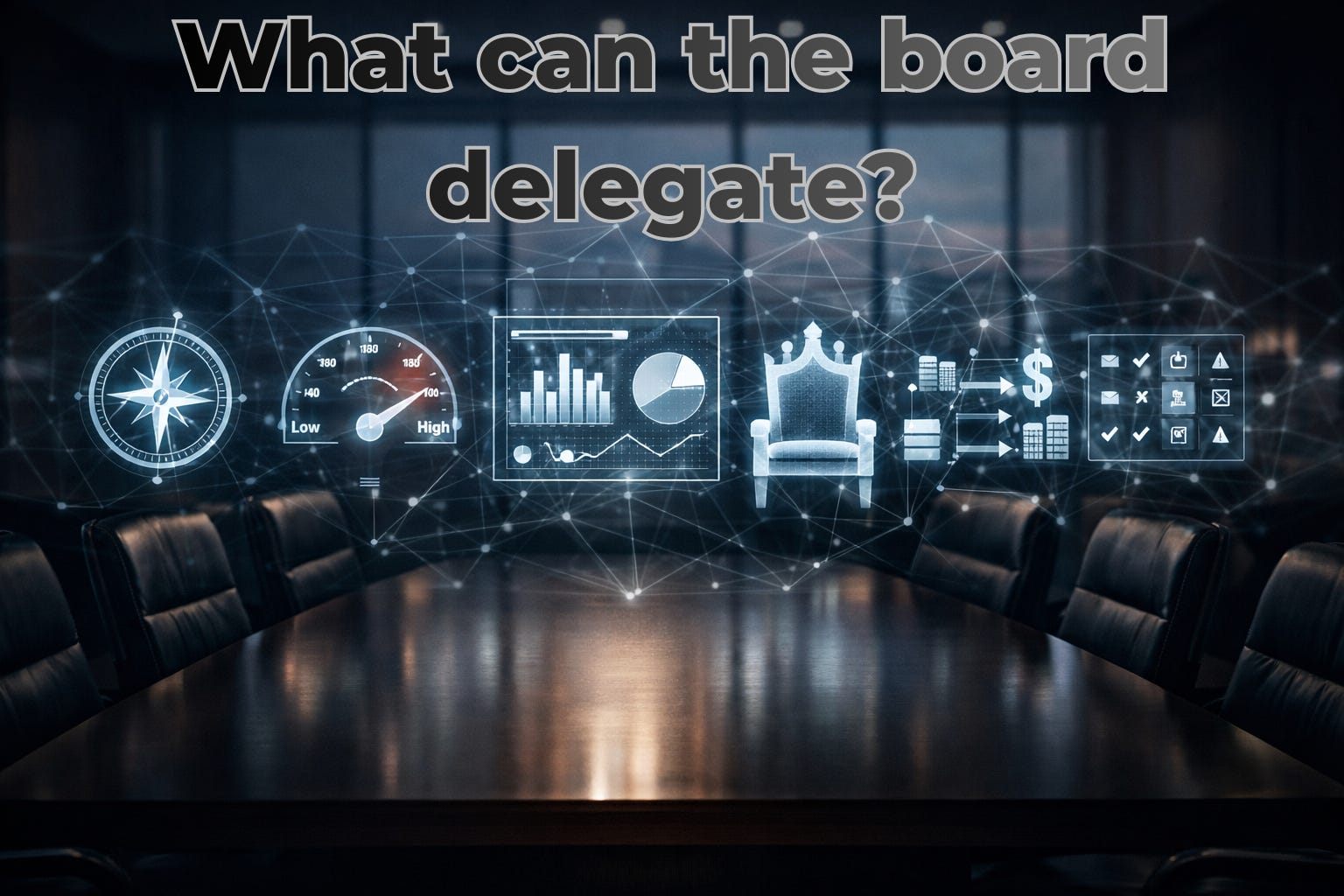
First, the company’s intention. Strategy language can make this sound abstract, but the real question is simple: what is this company for, and what is it trying to become? Another way to say it is the intention of the company. Governance frameworks reserve strategy and direction to the board because these are not just target-setting exercises. They are choices about purpose, tradeoff, and identity. AI now affects all of them. It changes what the company can pursue, how quickly it can reposition, what capabilities suddenly matter, and which strategic paths begin to look irresistible. That does not make intention delegable. It makes human ownership of intention more important.
Risk Cannot Be Outsourced by Dashboard
Second, risk appetite and major risk oversight. Not risk administration. Not dashboards. Not the machinery of controls. The real judgment is about which risks are acceptable in pursuit of value and which are not. The board should retain final responsibility for oversight of the company’s risk-management system and the integrity of reporting systems. AI raises the stakes here because it is both an opportunity and a new risk source at the same time: model risk, cyber risk, operational risk, legal exposure, and reputational damage can all arrive through the same deployment. That means AI does not sit beside risk appetite; it now helps define it.
Seeing Reality Clearly Is Still a Governance Duty
Third, the integrity of reporting and controls. In the AI era, this category becomes even more important, not less. Leaders may start confusing volume of reporting with integrity of reporting. They are not the same. The board’s obligation is not to receive more information. It is to ensure it is seeing reality clearly enough to govern. AI increasingly shapes what gets summarized, surfaced, ranked, escalated, or suppressed. It mediates the management picture. So the governance question is no longer only whether reporting systems exist. It is whether the organization still knows what is true.
Leadership Choice Is Not a Screening Problem
Fourth, CEO selection, evaluation, and succession. This has long been treated as a board-level responsibility because leadership choice is not simply a personnel decision. It is a directional decision. It sets standards, cadence, judgment style, and trust. AI now changes the context of leadership itself. It affects what kind of leader is needed, how performance is measured, and what capabilities matter at the top. It may help with pattern recognition or benchmarking, but it cannot decide what the moment requires in a leader, nor can it bear responsibility if that choice proves wrong. And there is a further complication: once AI enters search, screening, and evaluation, it can also introduce or scale bias in selection. That means even using AI to support succession planning requires explicit governance over what signals are being used, what assumptions are being encoded, and whether the system is narrowing leadership judgment under the appearance of objectivity.
Capital Allocation Declares Intent
Fifth, capital allocation and major structural decisions. The legal system gives a narrow signal here in the list of acts committees cannot take on their own. But the broader principle matters more: decisions that commit the company’s resources in ways that materially alter its future belong to accountable humans. AI now changes which investments look compelling, which capabilities appear obsolete, and which restructurings seem rational. Capital is not just fuel. It is declared intent. Where the money goes is where the company is going. That is why capital allocation cannot quietly drift into machine logic without explicit human ownership.
Culture Is Governance at Scale
Sixth, ethics, culture, and compliance posture. This category is often treated as soft until it fails. Then suddenly everyone remembers it was governance all along. Boards are expected to establish purpose, values, and strategy, and monitor whether culture aligns with them. AI makes this more consequential because it can scale hidden assumptions, reinforce incentives, and normalize conduct patterns faster than legacy controls can see them. A company cannot claim surprise when its systems amplify the values it encoded or tolerated. The board may not write every policy, but it remains responsible for the conduct regime the organization actually lives inside.
The Human Signature of the Firm
Taken together, these are not just reserved matters. They are the company’s human signature.
They answer the questions no machine should be left to settle alone: What are we for? Whom do we serve? What will we optimize? What will we refuse? How much risk will we carry? What reality do we insist on seeing clearly? Who leads? What behavior counts as success here?
These are not efficiency questions. They are stewardship questions.
When Delegation Turns into Drift
That is why the language of delegation becomes so dangerous once cognitive systems are embedded in the enterprise. Delegation sounds responsible. It sounds disciplined. It sounds modern. But many leaders are not actually delegating in the classical sense. They are drifting. They are allowing the recommendation layer to become the judgment layer without ever saying so out loud.
That is how institutions lose their grip.
Not all at once. Not through a dramatic surrender. But through a sequence of seemingly reasonable moves: let the model prioritize, let the workflow route, let the scoring system rank, let the exception engine determine what rises, let the monitoring layer decide what matters, let the dashboard define performance, let the system’s pattern become the organization’s posture. Eventually no one can point to the moment judgment moved. But it moved.
And once it moves, accountability becomes theatrical.
The Performance of Oversight
The board still meets. The executives still review. The committees still receive reports. But the substantive direction of the company has already been shaped elsewhere, upstream, inside encoded assumptions that no one fully owns and everyone treats as neutral.
They are not neutral.
Every system carries an implied theory of value. Every ranking system embeds a logic of importance. Every optimization routine privileges one outcome over another. Every automated escalation path expresses a view about what deserves human attention. That is why the non-delegable core matters more now than it did before. The machine is not only helping execute decisions. It is increasingly helping constitute them.
The Standard Now
So the task of governance is no longer merely to ask whether a decision was reviewed.
It is to ask whether the judgment inside that decision remained visibly human where it needed to remain human.
That is the standard.
Not that humans touched the workflow.
Not that a committee existed.
Not that there was an override somewhere in the system.
But that the enterprise-defining judgments remained unmistakably owned by people who understood that ownership could not be passed along with the convenience of the tool.
Not Anti-AI, Anti-Abdication
This is not an argument against AI.
It is an argument against abdication disguised as modernization.
The better these systems get, the more discipline leaders will need. Because the pressure will not come from incompetence. It will come from capability. The system will often be faster than the meeting, more consistent than the manager, and more comprehensive than the memo. That is exactly why leaders will need to know, in advance, what they refuse to delegate.
The non-delegable core is not the set of decisions AI cannot touch. It is the set of decisions AI can touch so deeply that leaders must become more explicit about ownership.
What Comes Next
The next question is not whether AI belongs in these decisions. It already does. The next question is how AI changes each of them: how it reshapes intention, alters risk, mediates reporting, changes leadership demands, redirects capital, and scales culture. That is where governance now has to go.
The future of governance will belong, in part, to leaders who can answer one question clearly: which judgments may be informed broadly, but must still be owned unmistakably?
This essay is part of an ongoing series examining how leadership, judgment, and responsibility are shifting as AI systems begin to participate in thinking itself.
On Mondays, the focus is leadership posture, governance, and board-level responsibility. On Thursdays, the lens turns to work, human consequence, and the lived impact inside organizations.
The next essay continues this exploration from the perspective of work and generational friction.
Introduction: The Experiment Is Over
Part 7: Who Gave the Bot Authority?
Part 8 : Delegation Is Not Oversight
Part 10: Who Can Overrule the Machine?
Part 11: Some Decisions Cannot Be Delegated
Part 12: When Nobody Owns the Call
Part 13: Governance Is Already Broken (You Just Can’t See It Yet)