

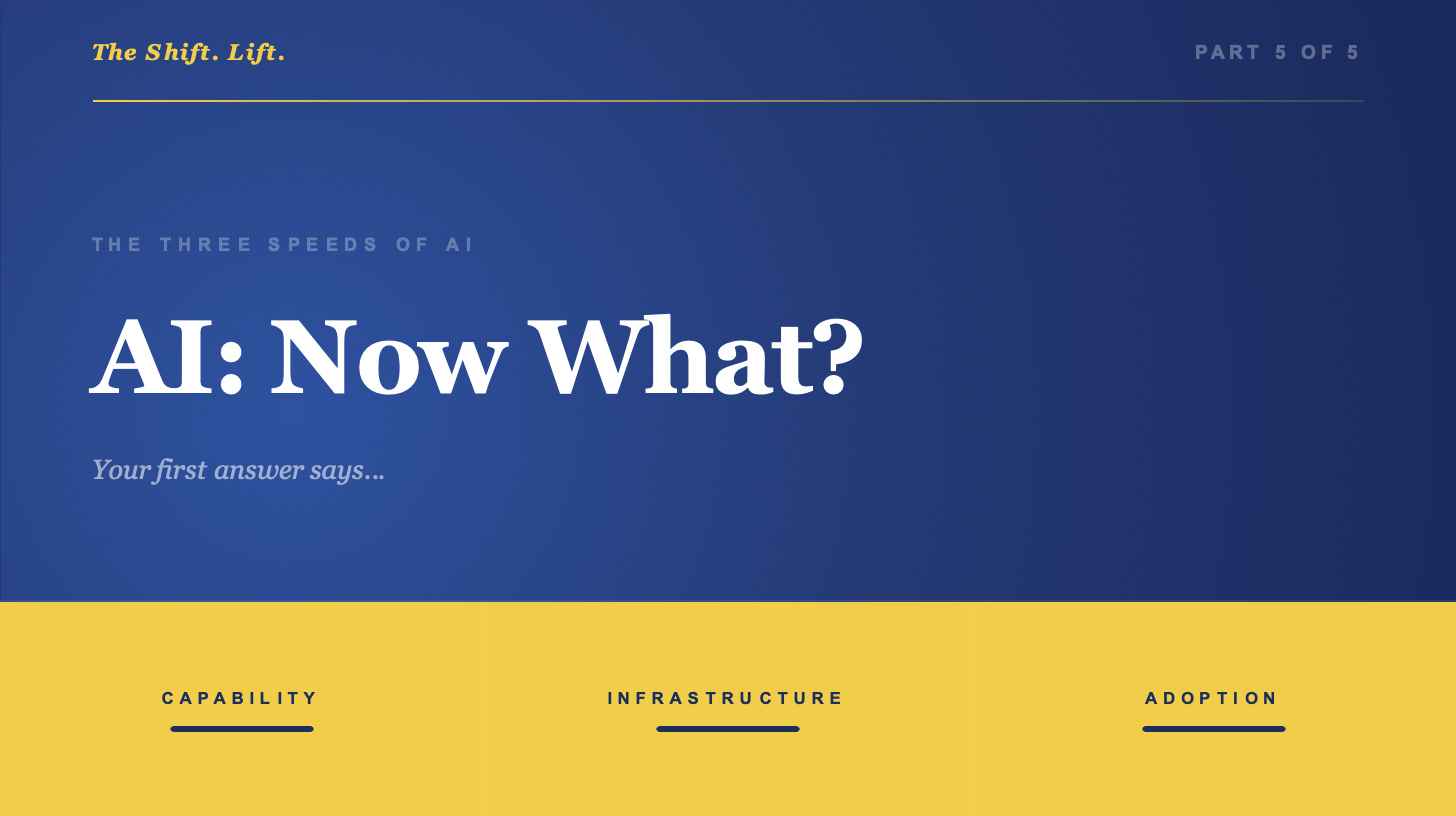
The Three Speeds of AI | Part 5 of 5

This is the final piece in a five-part series on the three speeds of AI. The series argument: AI is moving at three decoupled speeds — capability, infrastructure, and adoption — and most leaders are calibrating to the slowest and least predictive of the three. Part 1 established the framework. Part 2 looked at the capability gap you can’t buy your way out of. Part 3 examined infrastructure as a directional signal, not a stock market story. Part 4 showed why adoption data confirms whatever you already believe. This piece asks what you do with all of it. [Part 1] | [Part 2] | [Part 3] | [Part 4]
AI: now what?
Take a second. Don’t skim past it. What actually came to mind?
Really think about it.
Whatever surfaced — fast or slow, confident or blank, a tool you should be using or a worry you haven’t resolved or a vague sense that someone in your organization is handling it — that first instinct is data.
Not a verdict. Data.
Because your first answer almost certainly anchored itself in one of three places.
If what came to mind was a tool, a deployment decision, a question about what competitors are implementing, or a sense of how far along your organization is — you reached for the adoption layer. The visible one. The measured one. The one with the least predictive power about what determines your operating environment in three to five years.
If what came to mind was a question about what’s now possible that wasn’t six months ago — what decisions you could make today that you couldn’t have made last year — you reached for capability. The step-change layer. The one that reshapes the question set before adoption reflects it.
If what came to mind was the scale of capital being committed, the direction being set by the organizations building this infrastructure, what the competitive baseline will look like when the capacity being built today comes online — you reached for infrastructure. The rarest instinct among the leaders I work with. And that rarity is itself the signal.
None of these anchors is wrong. What matters is knowing which one you reached for — because that’s the layer you’re leading from.
The Shift·Lift subscribers have full access to all past articles, including the work that led into this series. Be sure to order your copy of CRAFT Thinking™ available on Amazon; Free for Kindle Unlimited readers.
There are hundreds of documented cognitive biases. In most governance conversations, the ones that get the most attention are overconfidence, confirmation bias, sunk cost. These are real. They matter.
But in AI leadership right now, the most consequential bias is simpler and less discussed: you anchor toward the layer you can see. Leaders perceive what reaches them. What reaches most private company leaders — through workforce conversations, board reports, peer comparisons, vendor pitches — is adoption. And so adoption becomes the frame through which AI is understood, assessed, and acted on.
This isn’t negligence. It is the entirely predictable result of where these leaders sit in the system. The adoption layer is the one proximate to their experience. It confirms what they can observe. It provides comparisons they can act on.
The problem isn’t the anchor. It’s not knowing you have one.
That’s what this framework is for.
Not to tell you what to do. Not to prescribe a technology agenda or a governance structure or an implementation timeline. The Three Speeds framework does one thing: it shows you where you’re standing so that where you stand becomes a choice rather than a default.
The questions worth sitting with regularly aren’t complicated. When someone asks about your AI posture, which layer do you naturally reach for first — and is that the layer doing the most to determine your next three years? In the last 90 days, what have you learned about AI capability that changed how you think about a specific decision? What infrastructure signals are you tracking — and how are they informing how you’re positioning now? When did you last encounter an AI reality genuinely different from your own?
These aren’t assessment questions with right answers. They’re calibration questions. The honest answers tell you which speeds you’re navigating by — and which ones you’re navigating blind.
This series opened with a question: which layer am I actually using to navigate?
You have four pieces of context now that you didn’t have in Part 1. The question means something different than it did when you first encountered it.
The goal was never perfect calibration. It was deliberate calibration — knowing which layer you’re leading from, so that choice belongs to you rather than to whatever signal happens to reach you first.
That’s the work. It doesn’t end here.
The Three Speeds of AI is a five-part series published in The Shift. Lift. If this framework is useful, the next step is applying it. Start by answering the calibration questions above — honestly, without optimizing for the right answer. Where you land is where the work begins.